 English
  Norwegian Bokmål
 DNAqua-Net: a COST-Action for developing new genetic tools for bioassessment of aquatic ecosystems in Europe
From the COST-Action CA152119 website: The protection, preservation and restoration of aquatic ecosystems and their functions is of global importance. For European states it became legally binding mainly through the EU-Water Framework Directive (WFD). In order to assess the ecological status of a given water body, aquatic biodiversity data are obtained and compared to a reference water body. The quantified mismatch thus obtained determines the extent of potential management actions. The current approach to biodiversity assessment is based on morpho-taxonomy. This approach has many drawback such as being time consuming, limited in temporal and spatial resolution, and error-prone due to variation of individual taxonomic expertise of the analysts. Novel genomic tools can overcome many of the aforesaid problems and could complement or even replace traditional bioassessment. Yet, a plethora of approaches are independently developed in different institutions, thereby hampering any concerted routine application. The goal of this Action is to nucleate a group of researchers across disciplines with the task to identify gold-standard genomic tools and novel eco-genomic indices for routine application for biodiversity assessments of European water bodies. Furthermore, DNAqua-Net will provide a platform for training of the next generation of European researchers preparing them for the new technologies. Jointly with water managers, politicians and other stakeholders, the group will develop a conceptual framework for the standard application of eco-genomic tools as part of legally binding assessments.
The inaugural meeting of DNAqua-Net was held in the COST-building in Brussels on October 20, 2016. The COST-Action was formally accepted and chair and working group leaders were elected. So far 31 countries are associated with the action, med representatives in the Management Committee nominated by national COST-coordinators. The delegates from Norway are Trude Vrålstad (Norwegian Veterinary Institute) and Torbjørn Ekrem (NTNU University Museum). The first conference of DNAqua-Net will be held in Essen, Germany, March 6-8, 2017, with post conference meetings in the five working groups (leads in parentheses):
- DNA Barcode References (Torbjørn Ekrem, Norge + Fédor Ciampor, Slovakia)
- Biotic Indices & Metrics (Jan Pawlowski, Sveits + Maria Kahlert, Sverige)
- Lab & Field Protocols (Kat Bruce, UK + Emre Keskin, Tyrkia)
- Data Analysis & Storage (Kessy Abarenko, Estland + Diego Fontaneto, Italia)
- Implementation Strategies & Legal Issues (Patricia Mergen, Belgia + Daniel Hering, Tyskland)
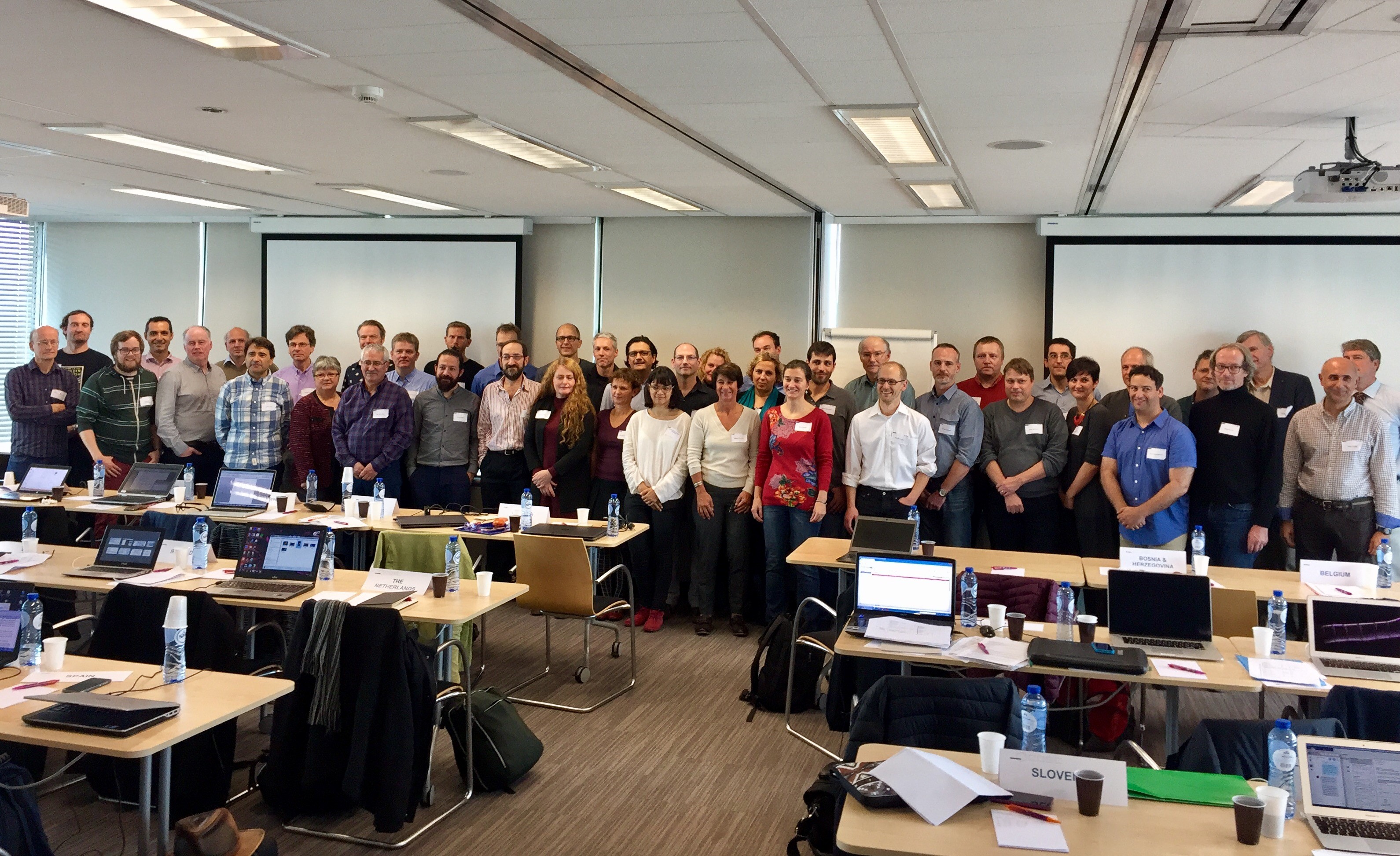 Participants at the inaugural meeting in the COST-Action DNAqua-Net.